

Table of Contents
Ethereum co-founder Vitalik Buterin is calling for a fundamental rethink of the role of layer 2 networks, arguing that Ethereum’s original rollup-centric scaling vision no longer reflects how the network is evolving.
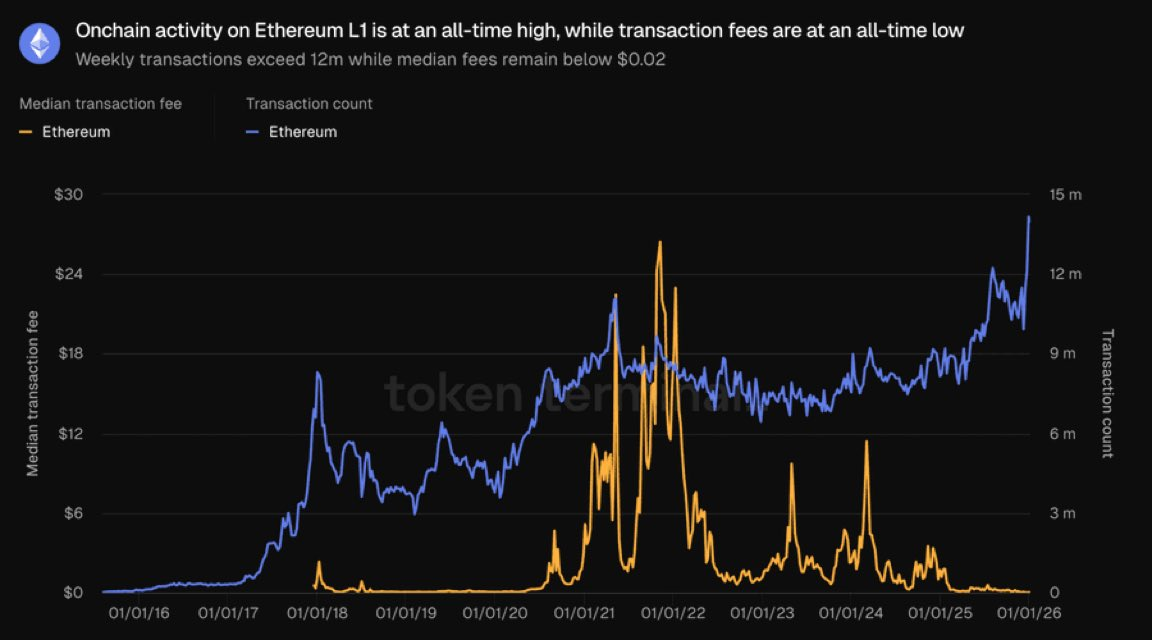
In a post shared today, Buterin said two developments have reshaped the discussion around L2s. Progress toward fully trustless stage 2 rollups has been far slower and more complex than expected, while Ethereum’s layer 1 has begun scaling directly, with low transaction fees today and significant gas limit increases projected for 2026.
“The original vision of L2s and their role in Ethereum no longer makes sense, and we need a new path,” Buterin wrote.
Ethereum’s rollup-centric roadmap initially framed L2s as extensions of Ethereum itself, sometimes described as branded shards. Under that model, rollups were expected to inherit Ethereum’s full security guarantees, ensuring transactions were valid, uncensored, and irreversible as long as Ethereum continued to function.
But Buterin said that framing no longer holds.
With Ethereum scaling directly on L1, rollups are no longer required to function as de facto shards. At the same time, many L2s have stopped short of pursuing full decentralization, often remaining at stage 1, where upgrade keys or security councils retain control.
In some cases, Buterin noted, rollups may never advance further due to regulatory or business requirements that demand ultimate control. While that may be the right choice for certain applications, he said it should be clearly distinguished from the goal of scaling Ethereum itself.
Instead of treating L2s as uniform extensions of Ethereum, Buterin proposed viewing them as a spectrum. That spectrum includes rollups that fully inherit Ethereum’s security, as well as chains with looser connections to Ethereum that users can choose to trust or ignore depending on their needs.
Under this model, L2s should focus on differentiated value rather than scaling alone. Buterin pointed to areas such as privacy-focused virtual machines, application-specific efficiency, ultra-low latency execution, non-financial use cases like social and identity systems, and specialized features such as built-in oracles or dispute resolution.
He also argued that any L2 handling ETH or Ethereum-issued assets should reach at least stage 1 decentralization. Anything less, he said, is effectively a separate layer 1 with a bridge.
On the protocol side, Buterin highlighted growing support for a native rollup precompile on Ethereum. The idea would embed zero-knowledge EVM verification directly into Ethereum, allowing rollups to verify EVM execution as part of the base protocol. Because it would be enshrined in Ethereum itself, the precompile would automatically upgrade alongside the network and be fixed via hard fork if bugs are discovered.
Such a mechanism could remove the need for security councils while enabling stronger, trust-minimized interoperability between Ethereum and rollups. It would also make it easier for rollups to extend the EVM with additional features while relying on Ethereum for core verification.
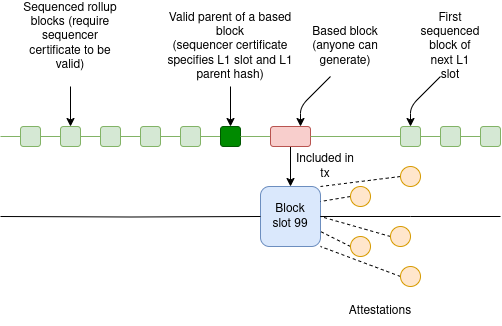
The post builds on related research Buterin has published on synchronous composability, which explores combining sequenced rollups with based rollups. Sequenced rollups offer low latency through offchain ordering, while based rollups enable composability with Ethereum by letting L1 determine transaction ordering.
Buterin outlined a hybrid design that introduces different types of L2 blocks, allowing sequencers to provide fast execution most of the time while preserving composability with Ethereum at specific points. The approach requires rollups to accept reverts if Ethereum reorgs and does not fully achieve permissionless block production without additional forced-inclusion mechanisms.
Buterin acknowledged that not all L2s will prioritize trust minimization or security, and consider that unavoidable in a permissionless ecosystem.
“Our job should be to make it clear to users what guarantees they have,” he wrote, “and to build up the strongest Ethereum that we can.”
This post is the latest in what has been an active comms period since the year kicked off. He's commented on decentralized social, DAOs, and on January 16th said, "2026 is the year we take back lost ground in computing self-sovereignty."
Investors have welcomed Buterin's renewed cypherpunk tone.
Observed in combination with Ethereum daily transactions surging to a new all-time high, setting a new highest weekly rate of new wallet creation, and transaction fees at an all-time low amid the activity surge, the momentum in the ecosystem (and bullishness despite the market sell-off) is palpable.