Table of Contents
As Solana pushes deeper into becoming what some in crypto now describe as a decentralized Nasdaq, the competition to land transactions faster, cheaper, and more reliably is intensifying. That pressure is especially acute for low-latency actors such as market makers, arbitrageurs, liquidation bots, and high-frequency trading systems, all of which depend on millisecond-level execution advantages to remain competitive.
Today, RockawayX announced the launch of Zela, a new remote procedure execution (RPE) platform designed to compress the entire Solana transaction workflow into a single near-validator execution process. The platform combines colocation infrastructure, private fiber routing through DoubleZero, high-staked transaction forwarding, and future support for raw shred delivery into what the firm describes as a unified execution stack purpose-built for Solana’s next architectural era.
According to RockawayX, Zela is designed to address what it sees as one of Solana’s biggest emerging bottlenecks: transaction landing complexity.\
As @solana grows closer to decentralized NASDAQ, the importance of transaction landing services for low-latency traders and apps is increasing meaningfully.
— RockawayX 📍 Miami (@Rockaway_X) May 6, 2026
That's why we’re launching Zela, the most architecturally advanced execution platform on Solana.
Zela is a Remote…
Solana’s Transaction Market Is Becoming Increasingly Complex
The launch comes as Solana’s transaction environment grows significantly more sophisticated, particularly for participants competing in latency-sensitive markets.
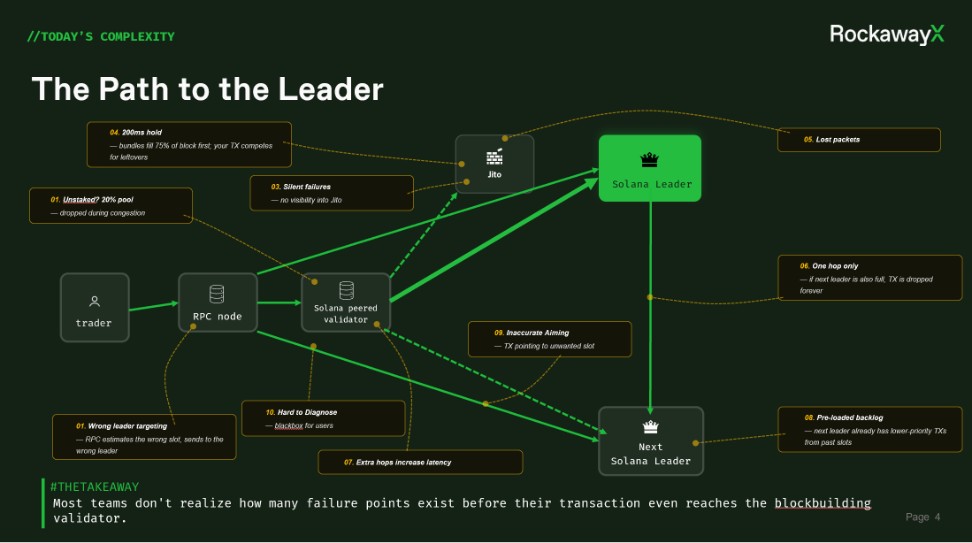
RockawayX argues that today’s transaction landing ecosystem is fragmented across dozens of providers, routing paths, and execution strategies. Traders often rely on a mix of RPC providers, TPU routing, bundles, stake-weighted forwarding, and validator plugins in an effort to improve inclusion probability. Even then, transactions can silently disappear before ever reaching the validator leader.
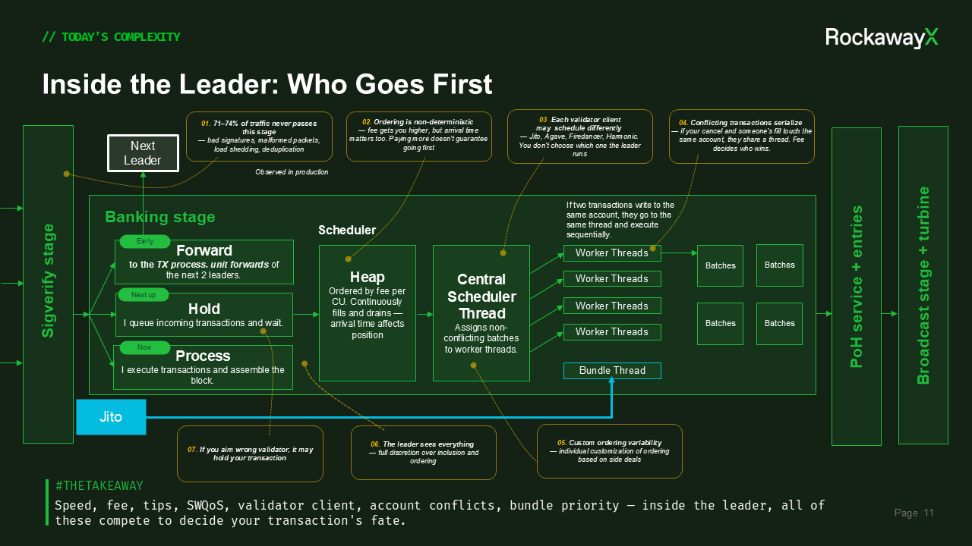
The company cited several statistics illustrating the current state of network congestion and inefficiency, including claims that 74% of ingress traffic consists of duplicate transactions, while bot-sent transactions experience a 58% failure rate. According to the firm, only 1.3% of raw transaction ingress attempts that reach the leader ultimately make it into a block.
RockawayX says this environment creates hidden costs across the ecosystem. Validators face higher hardware requirements, traders waste bandwidth and compute resources repeatedly broadcasting duplicate transactions, and retail users ultimately absorb wider spreads and higher execution costs.
The issue, according to the firm, extends beyond Solana’s scheduler design. Much of the complexity happens before a transaction ever reaches the validator itself. Transactions may be routed to the wrong leader, delayed by network jitter, deprioritized during congestion, or crowded out by bundle infrastructure before the validator even evaluates them.
Inside the validator, competition becomes even more aggressive. Transactions compete for scheduler heap placement based on both timing and fee-per-compute-unit economics, while bundled transactions routed through the Jito Labs ecosystem can bypass certain validation stages entirely and receive preferential execution treatment during portions of the slot lifecycle.
RockawayX believes that this complexity is about to increase further as several major Solana upgrades begin rolling out.
Zela Is Built Around Remote Procedure Execution
At the center of Zela is RockawayX’s concept of remote procedure execution, or RPE.
Instead of relying on a traditional RPC workflow where a backend continuously communicates with the chain through multiple network round-trips, RPE executes application logic directly on infrastructure colocated near validators around the world. The goal is to collapse the entire execution process—read, compute, simulate, decide, and submit—into a single low-latency execution call performed near the block producer itself.
The system operates inside WebAssembly sandboxes distributed across globally colocated nodes positioned near Solana validators in locations such as Tokyo, Frankfurt, and Dubai. Zela’s routing layer continuously monitors slot leadership and dispatches execution requests to the executor closest to the current validator leader.
The platform also integrates DoubleZero’s private fiber infrastructure, which bypasses portions of the public internet and filters duplicate traffic before it reaches validators. RockawayX says this reduces unnecessary validator overhead while improving transaction quality and routing efficiency.
In the future, the company also plans to integrate raw shred delivery through DoubleZero Edge, which could provide earlier access to network state information for latency-sensitive participants.
RockawayX Says Solana 2.0 Expands Zela’s Importance
A major part of RockawayX’s thesis revolves around upcoming changes to Solana’s architecture, particularly the combined effects of Constellation, Alpenglow, Agave 4.0, and ACE.
The company believes these upgrades collectively shift competitive advantage toward topology-aware, low-latency infrastructure providers instead of simpler fee-based transaction strategies.
RockawayX places particular emphasis on Constellation, which introduces a multi-proposer architecture replacing the current single-leader model. Under the proposed design, multiple proposers operate simultaneously in short 50-millisecond cycles, increasing the importance of intelligently routing transactions across geographically distributed validators.
According to the firm, this environment favors infrastructure capable of parallelized routing and real-time network awareness, which aligns closely with Zela’s distributed colocation architecture.
The company also argues that Alpenglow’s changes to voting and data propagation could reduce congestion while improving state synchronization across globally distributed nodes. Meanwhile, Agave 4.0’s reduced reliance on stake-weighted quality of service may weaken the advantages currently enjoyed by heavily staked routing providers.
ACE introduces more nuanced implications. While certain smart contracts may eventually define their own ordering rules, RockawayX argues that much of the broader Solana ecosystem—including retail trading, arbitrage, and non-ACE-enabled applications—will still remain exposed to latency and transaction routing dynamics.
Taken together, the company sees Solana evolving into an increasingly complex execution environment where routing intelligence, colocation, and low-latency infrastructure become core competitive advantages instead of optional optimizations.
For teams looking to level up their transactions in that future, they can visit Zela's website to request early access.