Table of Contents
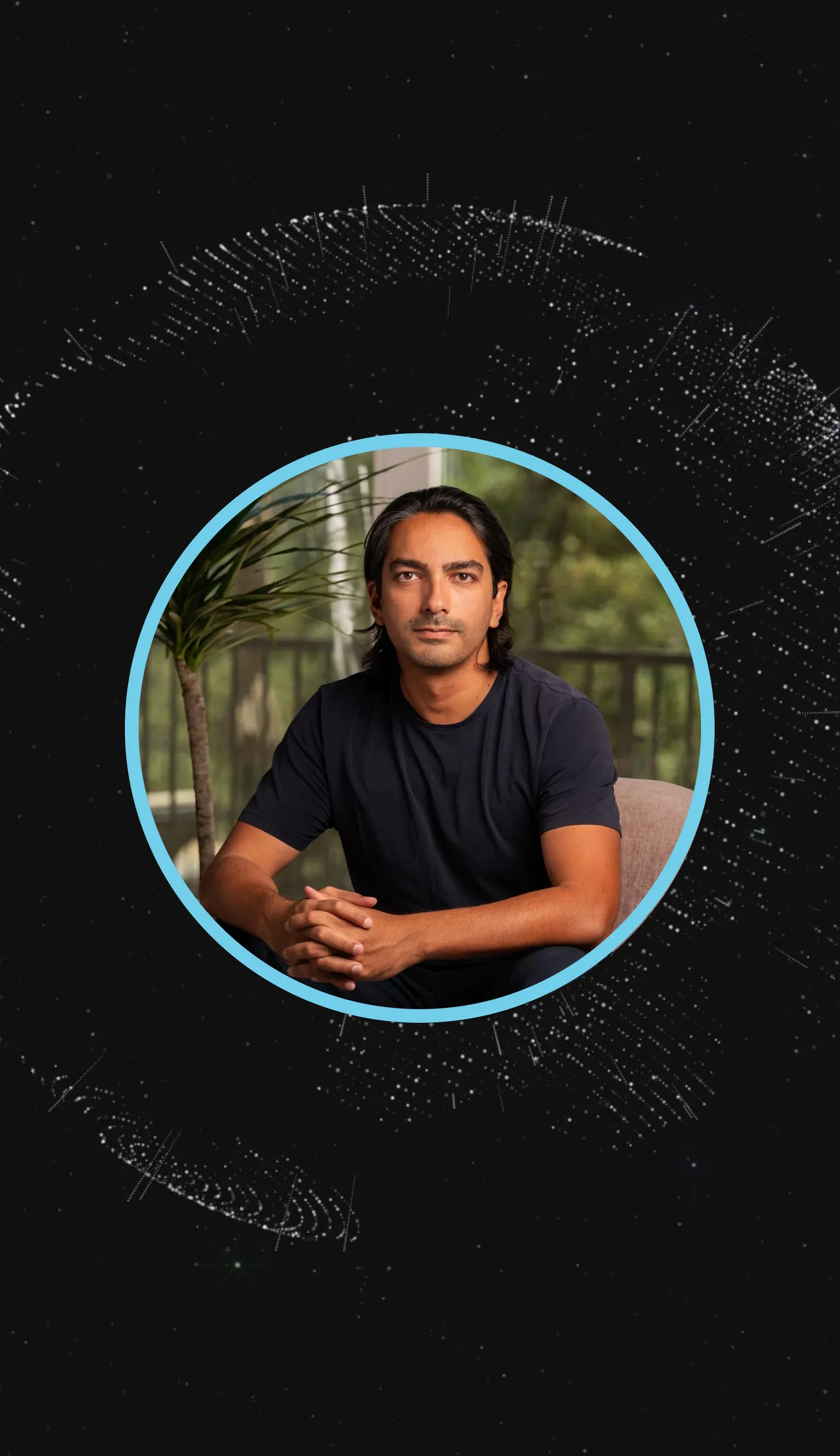
Haider Rafique is a long way from home.
Born in Pakistan with an original plan to become a filmmaker, it’s truly a marvel how he ended up in his role as OKX’s globetrotting CMO despite stacked odds against him.
This is how Haider rose to the top of crypto marketing and what it takes to get the job done daily.
Bringing Brutality to Marketing
Just as intriguing as Haider’s background is how chaotic his life has become since professionally joining the crypto industry in 2018—despite the unanimous consensus among friends and family that he was crazy.
Now, as a father to two sons, his free time demands focus on family, which means efficiency and productivity at work are more paramount than ever.
As the CMO of OKX, Haider says he’s managing 7-8 functions on any given day:
- Brand marketing
- Brand design
- Brand activations (partnerships, events)
- Product marketing across both centralized exchange and DeFi products
- A go-to-market team for institutional business
- A comms team consisting of PR, social media, email marketing, SEO, and more
If you feel tired just from reading that list, you’re not alone. How does Haider do it?
Because he’s rarely stationary, traveling internationally between conferences and OKX’s offices in San Jose, Singapore, and Hong Kong, Haider’s primary daily challenge is maintaining focus amid distractions attacking him from every angle.
He says the daily key is brutal prioritization.
“If you don’t have brutal prioritization, you end up finding yourself running around in every corner trying to have an impact… It’s not that hard for me to do it, it’s harder to maintain it and stay on that path… Ultimately that mental programming of making sure you know at any given time what your top 2-3 priorities are, and sticking to them, is the biggest challenge—not just for a CMO but any executive with a large team and a large scope.”
This doesn’t come easily. Every day is a fight, and sometimes, failure does occur.
When Haider finds himself falling out of a rhythm over time, the first thing he does is work to clean up both his physical and virtual surroundings. It’s a move that vanquishes much of the built-up chaotic outside noise and sets him back on track to focused productivity.
This pursuit of focus follows him everywhere, even at conferences where his attention, if not carefully guarded, can easily be pulled in a multitude of directions by those around him and hinder his performance as a speaker. Haider attends conferences to complete his mission and perform; it’s in his best interest to not drain himself through too much small talk.
“What I try to do—when I’m on the road especially—is use an app like Calm and do some self-meditation and try not to participate in every single conversation—save my time as much as I can. Those tend to be my go-to ways of managing a high-stress environment.”
The Evolution of a Lifelong Storyteller
Growing up, Haider had no desire to become a marketer. When he traveled to the United States to attend college, he was deadset on becoming a filmmaker.
His father, an aeronautical engineer who frequently traveled between Saudi Arabia and Pakistan for work, was fearful Haider would become another person living on someone else’s couch in L.A.—he did not approve of the filmmaking idea.
Respecting his father’s wishes, Haider switched majors to study journalism and advertising, as he was fascinated by how brands in the Western world could get millions of people behind their purpose through storytelling.
Through this curiosity, Haider’s career path change ultimately led to his first job in New York City with BBDO New York, one of the top advertising agencies in the city. The job wasn’t easily earned.
Haider was initially rejected from the company within five minutes of his interview's commencement. Only through six weeks of persistent follow-ups was he able to get his foot in the door with an unpaid internship—an effort that forever altered the course of his life.
Persistence and efforts, Haider says, have been themes of his life. He's had to earn everything, consistently advocate for himself, and prove his worth time and time again. It’s not the instantaneous token moonshot rags-to-riches story that typically gets attached to successful crypto industry participants by outside observers and the media. Haider’s journey was full of trials overcome by an enduring commitment to growth and passion for his craft.
A different job wasn’t the only thing that a change in collegiate major generated for Haider. It also further developed his passion for brand-connected experiences, which fuels him today in his role at OKX, one of the world’s leading cryptocurrency exchanges.
Haider’s path to OKX truly began when he lept into crypto professionally by joining Blockchain.info (which he rebranded to Blockchain.com) as their first head of growth.
Before assuming that role, Haider had been in a “less stressful” Director of Product Marketing role, which he took on upon leaving Microsoft because he had a family member struggling with health issues at the time. Three years into that role, Haider says he woke up one morning and was struck by a desire to do something more fun and engaging. This spark ignited his journey into crypto.
The expanding industry, particularly noticeable during the surge of new businesses and products in the 2017 bull market, had been steadily capturing his attention, convincing him of the industry's potential and prompting him to engage with it more seriously.
Once officially in crypto as a professional, Haider quickly recognized the distinct nature of marketing within Web3 versus conventional sectors. To date, marketing frequently takes a backseat in the dev-centric industry. He notes that many companies still don’t believe it’s the right time to properly initiate marketing efforts.
“There’s this resistance to marketing that comes naturally to technical co-founders, and the other point of view is that we’re not ready for prime-time until regulations are more clear. That has been the state of crypto marketing for a large part.”
On the other hand, Haider believes that the companies that have proceeded with marketing must rethink their communication strategies. He has witnessed an overwhelming majority of crypto ads released from 2021 onwards relate to a “revolution” theme, which is a mistake.
“Of course, it’s about a revolution, but the revolution already happened back in 2017, so why are we still talking about that now? If we’re going to be a mature industry that competes with, or compliments TradFi, then we need to have a different strategy. As a result of that, at OKX we took a very different marketing strategy. If you look at some of our ad campaigns, it’s not anything to do with revolutions.”
Inherently, calling crypto a revolution infers that it hasn’t happened yet. Any company marketing in this way could lead its audience to assume that it’s still too early to participate in whatever product or idea is being promoted. Therein lies a core mistake of crypto marketing today.
Beginning the OKX Era
To Haider, crypto was, and still is, an experience for humanity that isn’t optimal for billions of people worldwide. Today, he carries out a mission to change that as OKX’s CMO.
“I have a passion for creating, or helping create, products that are the ultimate experience for billions of people around the world. What attracted me to crypto was the fact that the experience wasn’t optimal for the 8 billion people in the world to really get behind it.”
Initially uncertain about accepting the job offer in 2020 because he was contemplating founding his own business, Haider found himself at a crossroads, needing to strongly consider his next move in the presence of external variables like the recent arrival of his newborn, among others. Ultimately, his ambition to witness the rise of leading companies from Asia, coupled with the timing around his growing family, proved to be a compelling mix that tipped the scales, leading Haider to embrace the opportunity.
 OKX
OKX
Initially, Haider saw OKX as an exchange with great engineering fundamentals that was hindered by a front-end unprepared for prime-time. Haider says situations like this complement his skillset and enable him to make the biggest positive impact.
“As a marketer and storyteller, I tend to have the biggest impact when you have a great product-market fit, and it’s a great technical product, but you don’t have a compelling global identity or compelling design. That’s where I’ve proven to have a massive impact. I hope everyone’s able to see that with what we achieved with OKX these last several years.”
Driving OKX to the Next Level
Today, after successfully navigating the crypto bear market, Haider is focused on leading his team to build trust back in the community and taking the OKX brand to new heights of global recognition.
Initially, the team focused on getting people to recognize the OKX logo through brand partnerships; recently, the goal has been connecting the brand with real products to further enhance visibility.

Haider still sees massive growth potential for OKX, as there are two sides to the business: a centralized side resembling a traditional brokerage platform, and a Web3 side.
For OKX, as well as other companies in the crypto industry, Haider sees the key to success as balancing Web3 tech with a well-created front-end that isn’t over-engineered. This will enable products and services to be built for the masses, not just the intimate crypto community currently in place.
“The opportunity for the crypto industry is to build this amazing technology, but also really focus on the consumer experience. Learn. Don’t have an ego, and take time to learn from the traditional consumer companies! Because if we don’t do it well, and we don’t simplify those experiences and make the onboarding very seamless, by the time we’re done building these technologies, the TradFi consumer companies will come in, take our technology, and build a front-end that consumers are more accepting of—they’ll win the consumer game.”
As Haider continues to evolve OKX, he’s keeping in mind that the media buying landscape is changing rapidly in front of us. It’s a marketing trend he’s excited to continue taking advantage of, as he believes Web3 currently maintains an advantage over traditional consumer companies
“The world is not buying into brands because they saw a banner ad on one of the websites. They’re buying brands, or they’re believing in brands and their purpose now if they’re part of a community.”
He feels that the traditional world is still stuck in its old ways of media buying. In contrast, the crypto industry is doing a much better job of building community and onboarding influencers on TikTok, Instagram, etc. that advocate for the brand and educate people about products in a much more engaging, personable way.
Assuming the crypto industry continues to press its community-building advantage and delivers a front-end experience that is primed to adopt billions of people, Haider is confident that leading crypto companies will not only survive but thrive, setting a new standard for the intersection of technology and user experience in the digital age.
Charting a Course for Financial Inclusivity
Haider heads into the future guided by his desire to see crypto change the world for the better. He is skeptical about the transparency of our current financial system but also casts a doubtful eye on whether society is ready to embrace the radical transparency offered by blockchain technology.
This transparency isn't just about shedding light on transactions; it's a larger question of whether companies and individuals are prepared for this level of openness. The implications are vast, with the potential to alter the very fabric of corporate confidentiality and personal privacy. What's at stake is not just information, but the dynamics of trust and discretion that currently underpin financial exchanges.
Furthermore, Haider believes that cryptocurrencies and their underlying technologies have a democratizing effect on finance. By breaking down barriers to entry, crypto platforms could level the playing field, offering unprecedented access to financial tools and services. This could empower people traditionally marginalized by the financial establishment, offering them a stake in a system from which they have long felt excluded.
The dilemma Haider presents is the balance between the benefits of openness and the risks of overexposure. While the democratization of finance through crypto is a noble goal, the world must grapple with the fundamental changes that such transparency demands. It's a transformative vision, but one that requires careful consideration of its implications for privacy, security, and the social contract of trust in the financial domain.
One thing is certain: Haider and OKX will be at the forefront of the transformation.